
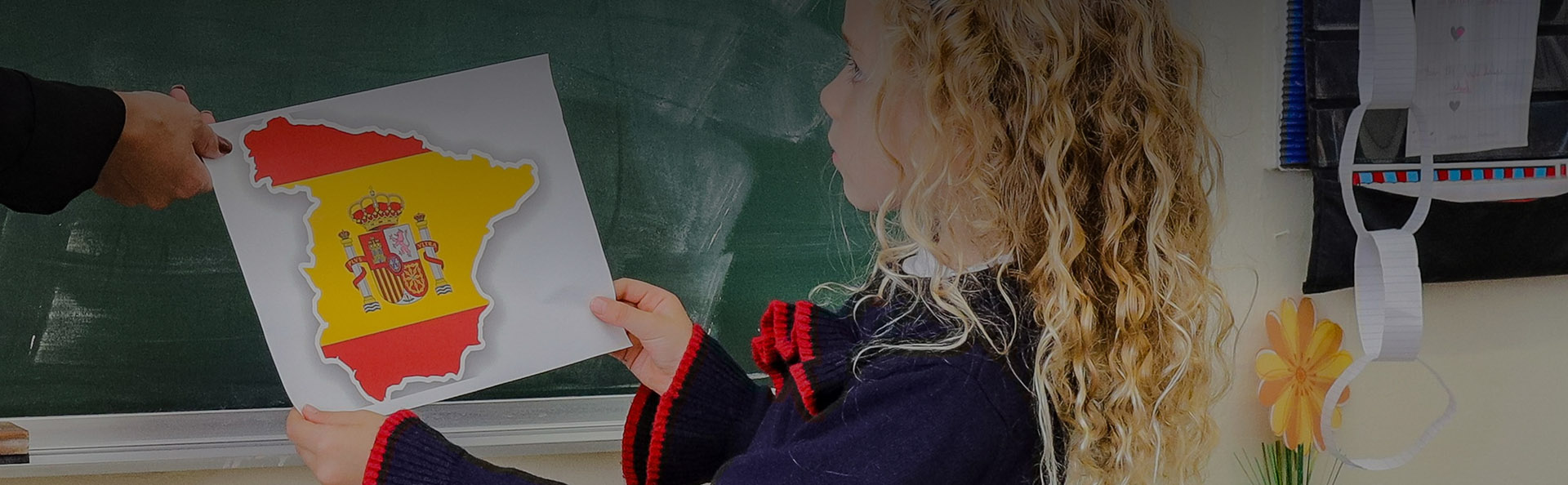
Spanish
The teaching of the Spanish language in our school is embedded within the educational framework of the Montessori method, which places the student at the center of the learning process as an active participant. The foreign language is not presented as a set of abstract rules, but as a living tool for communication, cultural discovery, and personal growth.
The Spanish program is designed as a vertical and continuous pathway, from the second year of primary school through the third year of lower secondary school, without rigid divisions by grade level.
In the early years, the approach is mainly oral and experiential: through games, songs, stories, movement, and daily routines, students develop familiarity with the sounds of the language, acquire basic vocabulary, and begin to understand and use simple expressions related to everyday life. As the program progresses, oral skills are strengthened and written language is gradually introduced, always within meaningful and functional contexts.
During lower secondary school, the study of Spanish becomes more structured while maintaining a communicative and active approach. The four language skills—listening, speaking, reading, and writing—are integrated and further developed, fostering greater autonomy, expressive accuracy, and interaction skills. The pathway concludes with targeted preparation for the final Instituto Cervantes examination, which provides an official certification of the language competencies acquired.
The teaching approach is communicative and functional, consistent with Montessori principles, and is based on:
· the centrality of direct experience and learning by doing;
· the use of concrete materials;
· learning through movement, play, dialogue, and discovery;
· the promotion of autonomy and self-correction;
· the creation of a calm, non-competitive learning environment.
General Objectives
By the end of the program, students will be able to:
· understand and use Spanish in authentic communicative situations;
· develop a positive, curious, and open attitude toward foreign languages;
· gain awareness of similarities and differences between Spanish, Italian, and English;
· become familiar with key aspects of the cultures of the Spanish-speaking world;
· confidently take the final Instituto Cervantes examination.